
We will try to simply answer questions: What is an Anal Fistula? What are the methods of treating an anal fistula? What are the methods of preventing it and avoiding its occurrence or recurrence? What are the causes of an Anal Fistula?
Definition of Anal Fistula:
It is an abnormal tract or a channel connection between the inside of the anus or rectum on one end and the outside of the body on the other. This means that there is an opening for the channel inside the anus and another opening on the skin outside and adjacent to the anus, from which yellowish secretions are discharged.
Symptoms of Anal Fistula:
– Presence of an opening or a small pimple-like near the anus.
Yellowish or slightly reddish discharge near and around the anus
Swelling or pain near the anus
– Recurrent pari-anal abscesses
Causes of Anal Fistula:
Fistulas usually form several weeks after an abscess around the anus or rectum. They develop when the abscess is not treated and drained fast enough.
An abscess is a painful collection of pus that needs to be drained. If left untreated for a few days, the abscess will spontaneously find an outlet through the nearest opening inside the anus, which is later known as the “internal fistula opening.” The abscess will also create another opening on the skin near the anus (the “external opening”), either spontaneously or surgically. The patient will notice secretions oozing from the external opening. See the image.
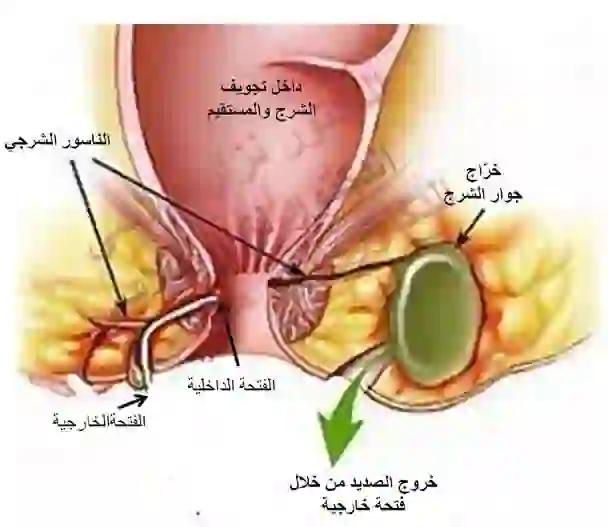
After several weeks of spontaneous drainage of an abscess or delayed surgical drainage, an anal fistula may form, which is the channel connecting the internal and external openings.
Terminologies used in Anal Fistula:
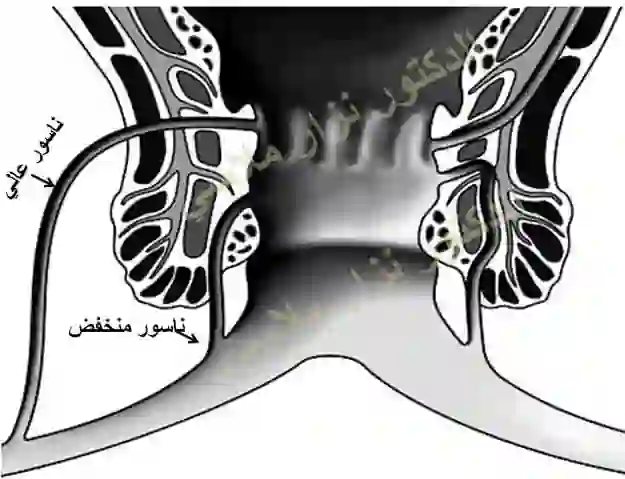
Low Anal Fistula: The internal opening (see above) is low and close inside the anus.
High Anal Fistula: The internal opening (see above) is high, i.e. deep, inside the anus.
Branching Anal fistula: This usually occurs when the fistula treatment is delayed, and repeated infections or repeated pus collections (abscesses) occurred within the fistula, which in turn leads to branches and the formation of other channels and openings connected to each other.
Treatment of Anal Fistula:
The standard treatment for a fistula is surgery, which is the medically approved method. There are numerous methods and techniques for performing this surgery. However, it is difficult to delve into the details of the operations in this simplified article. For more information on fistula surgery methods , click here.
Complications of Anal Aistula surgery:
One of the most important complications the doctor should avoid and pay attention to, is to preserve as much as possible the anal sphincter muscle which is responsible for voluntary control. Cutting this muscle during surgery may results in loss of control over defecation. Therefore, it’s best that the surgeon be familiar with the many different techniques available to manage Fistulae Anale.
For more information about the different fistula surgery techniques [click here]
Prevention of Fistula and avoiding its recurrence:
Delaying treatment of an abscess may lead to the formation of a fistula (so if pain or swelling occurs near the anus, you should consult your surgeon to manage an abscess if present).
Delaying treatment of a fistula and recurrent infections may, in turn, transform a simple fistula into a branched or complex one. (Do not delay consulting a surgeon to treat this condition.)

